In order for us to
answer this question it is necessary to define three points: who would “we” be, what the Amazon is and what the meaning of owning something is. To establish the “we”, let us begin by determining what we understand by the Amazon. The Amazon rainforest is the
second largest biome in the world, which extends along the area of nine
different countries. But to confine the “we”
to Brazilians only, let us delimit the “Amazon”
to the portion of the forest within Brazil’s borders. Having said that, can we
say that each one of the persons being born within the Brazilian state owns (or
is a shareholder of) a gigantic area of this forest? Let us now tackle the
third point; how do we become the owners of something? There are three ways of
acquiring proprietorship over something: (1) to buy it, (2) to receive it as a
gift or (3) to appropriate a previously unowned resource (homestead). In order
for one to appropriate something unowned it is necessary to establish an
objective bond with the resource in question, or, in the words of John Locke:
Every man has a
property in his own person. This nobody has a right to, but himself. The labour
of his body, and the work of his hands, we may say, are properly his.
Whatsoever then he removes out of the state that nature hath provided, and left
it in, he hath mixed his labour with, and joined to it something that is his
own, and thereby makes it his property. It being by him removed from the common
state nature hath placed it in, it hath by this labour something annexed to it,
that excludes the common right of other men: for this labour being the
unquestionable property of the labourer, no man but he can have a right to what
that is once joined to. . . .[1]
Thus, what objective
bond have a waiter from Chui, a fisherman from Santos, a politician from Brasilia,
or even a Manaus dweller established with all of the Amazon rainforest on
Brazilian soil? None. Furthermore, not only has no single Brazilian citizen but
also no other person on the planet “mixed his labour” with the majority of such
resources, since, in reality, a large part of the forest has never been touched
by human beings. The forest is a vast and empty demographic area, a green
desert.
Privatization
So the Amazon belongs to the Brazilian State?
In fact, the Brazilian government possesses the territory where the Amazon
rainforest is located at; but does it have a legitimate ownership over this area? The difference between possession and
ownership can be illustrated by the example of a person who stole a watch and
walked away unpunished. The thief does posses
the watch, but the property remains of the victim, who has the right of
reclaiming it if the thief is caught. The possession of the territory under the
Brazilian government domain started to be delineated even before the
“discovery” of Brazil, in 1494, two years subsequent to the discovery of
America by Columbus, through the Treaty of Tordesillas, which stipulated that
lands that, by any chance, were located at the unexplored region of the planet
where Brazil was, belonged to the kingdom of Portugal. Logically, such
stipulation did not take into consideration which portions of this land were
already occupied at that period of time — before 1500, there were urban
complexes in the Amazon housing up to 50 thousand inhabitants — and, even if
it dealt with an empty continent, no person — not even a king — can claim
legitimate ownership over a resource he has not even yet found. This is also
known as the “Columbus Complex”:
Some theorists have maintained
— in what we might call the “Columbus complex” — that the first
discoverer of a new, unowned island or continent can rightfully own the entire
area by simply asserting his claim. (In that case, Columbus, if in fact he had
actually landed on the American continent — and if there had been no Indians
living there — could have rightfully asserted his private
“ownership” of the entire continent.) In natural fact, however, since
Columbus would only have been able actually to use, to “mix his labor
with,” a small part of the continent, the rest then properly continues to
be unowned until the next homesteaders arrive and carve out their rightful
property in parts of the continent.[2].
The current Brazilian
borders were defined through a series of similar
treaties, signed between governments. It is then clear that the Brazilian
government is not the legitimate owner of the forest area it declares to be
under its domain. Therefore, when one speaks about the “Amazon privatization”,
one is defending an as illegitimate arrangement as aforementioned, since no one
can sell that which has never been owned — and is not occupied by any person.
The privatization scenario, where the current state possession moves to private
hands can appear attractive to libertarians, but it would enable the government
to sell private individuals vast unoccupied areas — fatally to relatives or
allies of politicians — who would not, and could never, come to establish an objective
bond with the land.[3] During the
American colonization, there was an analogous situation to the Amazon
privatization. The kingdom of England declared itself the owner of the North
American territory and the settlers
had to buy the land
at prices far higher than the zero price that would have obtained without the
engrossment by the government and its pet grantees. Of course, the settlers
still had to spend money immigrating, clearing the land, etc., but at least no
arbitrary cost would have been imposed on top of these expenses.[4]
Consequently, neither
the government nor private individuals can sell unoccupied lands. All the state
could do in this question is get out of the way and recognize the property
rights of the people who occupy the areas, which are, today, under the possession of the
state.
Preservation
The motto “The Amazon
is ours” seems to have always been around, but in distinct ways. During the 60s
and the 70s, the military in power had an idea which contained many of the
aforementioned elements. With the notion that an unoccupied land is an
ownerless land, and adopting the slogan “Occupy not to hand in”, they took
measures to stimulate the settling in the Amazon region, among them opening
roads and granting tax exemptions — that is, the government declared that
whoever moved to the middle of the forest, far away from large consuming
centers and exporting channels, and founded enterprises, would be stolen to a
lesser extent than would be in other localities in Brazil. Manaus, which was
decadent and ever more disoccoupied since the end of the rubber golden period,
became once again a focus of migration, thanks to the Manaus Free Zone, where
today 1.8 million people inhabit. The roads built by the government provided
access to previously inhospitable areas. This arrangement facilitated the
extraction and appropriation of the natural resources in that region.
Curiously, it is exactly what the same state currently fights against.[5]
Formerly, the jungle
was considered what it really is: an
enemy to be tamed; that nature in its brute state is only valuable after
man occupies it and works the land, transforming or extracting resources from
it, what then becomes wealth, used to improve people’s standard of living. But,
today, an ecological wrath seems to have taken over the whole world, and the
people — obviously in their comforting homes in urban areas — have a fixed
idea in their minds that that which has not yet been touched by man, in such a
condition must remain. The reason behind it? We’d better not even ask.
A very popular belief
in the past, and still held sacred, is that the Amazon must be preserved
because it is the “world’s lung” — implying the forest is responsible for the
oxygen production in the atmosphere, or be it, responsible for life on earth.
Anyone who recalls the science lectures in school knows that plants carry out
the photosynthesis process during the day (exchanging CO2 for O2) and breathe
24 hours a day (exchanging O2 for CO2), or be it, forests do not produce O2;
what is great, since an increase in the concentration of O2 in the atmosphere
could mean the end of life on earth. It is a fact, that for over a million
years, the concentration of atmospheric gases has remained stable, with 76.5%
nitrogen, 20.5% oxygen and 1% other gases, besides 2% water steam.
However, nowadays it
seems the predominant ghost is global warming — the Amazon forest would
prevent the earth temperature from rising, because it would reduce the
concentration of CO2 in the atmosphere. But we are provided with no
explanation, since as we have just reminded the reader, plants, too, produce
CO2. There is also no explanation as to how a gas which comprises only 0.03% of
the atmosphere can drastically increase the earth’s temperature.[6] A while ago, scholars maintained that in case
the Amazon disappeared, the world would face a new Ice Age[7]. Furthermore, if
forests exert such an influence on the earth’s temperature,
didn’t it experience a dramatic variation (upward or downward) in the last
8,000 years, a period in which there was a more than 75 percent reduction in primary
forests’ areas, and the total area covered by forest diminished 40%? It is
hard to believe the remaining 60 percent has this vital importance resting in
it, as if life on the planet depended on the forestland left. Notwithstanding, there are studies about an anthropogenic origin
of the Amazon Forest, and recent deforestations enabled the
discovery of geoglyphs which date back to the XIII century, indicating
that, few centuries ago, that very region could have been a grassland similar
to the tropical savanna.
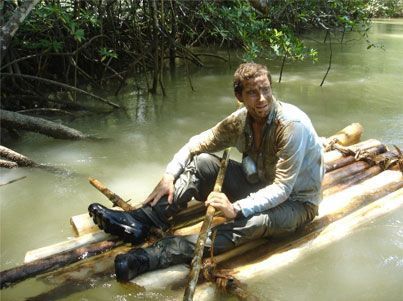 |
| Bear Grylls, protagonist of the series Man vs. Wild, also from the Discovery Channel, struggles to survive in the middle of the Amazon |
Another quixotic
argument which usually emerges is that the Amazon fauna and flora posses
properties yet unknown to man, and, therefore, must be preserved — “the cure
of cancer can lie in the Amazon!”. To
begin with, this could be an argument in favor of the maximal forest’s resource
exploitation, and not for its “immaculate maintenance”. He who holds such a
belief can head right now to the middle of the forestland and collect “these
riches”. In order for us to prove such an argument does exist, let us provide
an example. The recent television series by the Discovery Channel, entitled Battle for the Amazon,
justified this view by citing that a “possible cure to the Chagas disease had
been found in the poison of the Bothrops Jararaca”. There is only one problem
with this argument, this reptile can be found from the North of Mexico to
Argentine! Even if it were an exclusive Amazon
reptile, we would have a reason to capture and research every specie in the
region at a place like the Butantan
Institute (preferably not linked to the government), and not to leave an
area of oceanic dimensions untouched.
And it is with these
kinds of justifications that the government works hard to reduce everyone’s
standard of living, with IBAMA forbidding the deforestation in an area granted
to the government by the “Columbus Complex”, with the Federal Police attacking
and kidnapping human beings for having extracted the so-called “illegal wood”,
or arresting miserable men for capturing animals in the forestland — what has
been termed “wild animals trafficking” — or several other aggressions that
occur under the urbanoid’s acquiescence — people who would not last a single
day if left
to their own devices in the middle of the tropical forestland. Lew Rockwell makes a succinct analysis
of this environmentalist wrath: “It’s as if the socialists discovered that
their plan creates poverty, so they decided to change their name to
environmentalists and make poverty their goal.”. Along the same line of
reasoning, Jeffrey Tucker observes
that:
Are you seeing the
pattern here? Government planning was never a good means to do anything, but at
least there was a time when it set out to bring progress to humanity. It was
the wrong means to achieve the right goal. Today, government planning is
working as a maliciously effective means to achieve the wrong goal: I mean by
this that if there is anything that government is actually good at doing, it is
destroying things.
The famous
philosophical question that says “If a tree falls in the forest and no one is around,
does it make a sound?” could be adapted to our matter of discussion as “If a
tree remains in the forest and no one is around, is it really there?
Conclusion
No, the Amazon isn’t ours. Whoever catches it, gets to keep
it. And he’d better enjoy it well, transforming unused resources in goods
demanded by people, varying from ecological parks to sandal
ornaments.
_______________________________________________
Notes
[1] John Locke, Two Treatises of Government
(Portuguese edition), V. pp. 409-10, (Martins Fontes, 1998)
[2] Murray N. Rothbard, The Ethics of Liberty,
chap. 8, Ludwig von Mises Institute.
[3] This occurred with
Fernando de Noronha, who received in the captaincies system a few islands that
today take its name, but never really settled there. Even though, the
possession of the island passed onto the subsequent generations of the de
Noronha’s. After being occupied by Frenchmen and Dutchmen, the Portuguese
retook the island in 1737, transforming it in a prison-island which worked up
to 1942. Today, the Brazilian state controls the whole archipelago, allows a
few people to operate hotels and shops there, controls the number of people
permitted to visit the island and charges each and every visitor R$ 40 per day
for just being there.
[4] Murray N.
Rothbard, Conceived
in Liberty, Vol. I, p. 150
[5] According to the
environmentalist entity WWF,
roads have been great promoters of deforestation, and, in the Amazon, 75% of
deforestation occurred in large stretches along the asphalted roads.
[6] Wikipedia informs us
that the contribution to the greenhouse effect by a gas
is affected by both the characteristics of the gas and its abundance. For
example, on a molecule-for-molecule basis methane is about 72 times stronger
greenhouse gas than carbon dioxide over a 20 year time frame but it is present in much
smaller concentrations so that its total contribution is smaller. When these
gases are ranked by their contribution to the greenhouse effect, the most
important is water vapor, H2O, with 36 — 72 % contribution.
The carbon dioxide came only in second with 9 — 26 % contribution.
[7] The environmentalist
and Brazilian Secretary of the Environment from 1990 to 1992, José A.
Lutzenberger, used to say:
Today there are
fantastic instruments which allow us to see the globe in its entirety. If we go
to INPE (National Institute for Spatial Research), in São José dos Campos, or
even NASA, we can see on the computer screens the image of the Planet as a
whole, with the Amazon in the center, and all the movement of this mass of
clouds.[.]
If we look at these
satellite images again, showing the air currents which leave the Amazon heading
South and North, we realize that, if they disappear, we will face a new Ice Age
in Europe and maybe here in the extreme South. Therefore, it is futile to say,
as our governors and mainly our military wish, that which we do to the Amazon is
nobody’s business but ours. Quite the contrary, it is everybody’s business
indeed. It is the Planet’s business, a vital organ of the living being called
Gaia, namely the Earth. We can no longer keep destroying the Amazon. It must be
stopped. We need to rethink our concepts. Also because, under a purely
economical standpoint, that is plunder.
Translated by Fernando Ulrich
Nota: as visões expressas no artigo não são necessariamente aquelas do Instituto Mises Brasil.